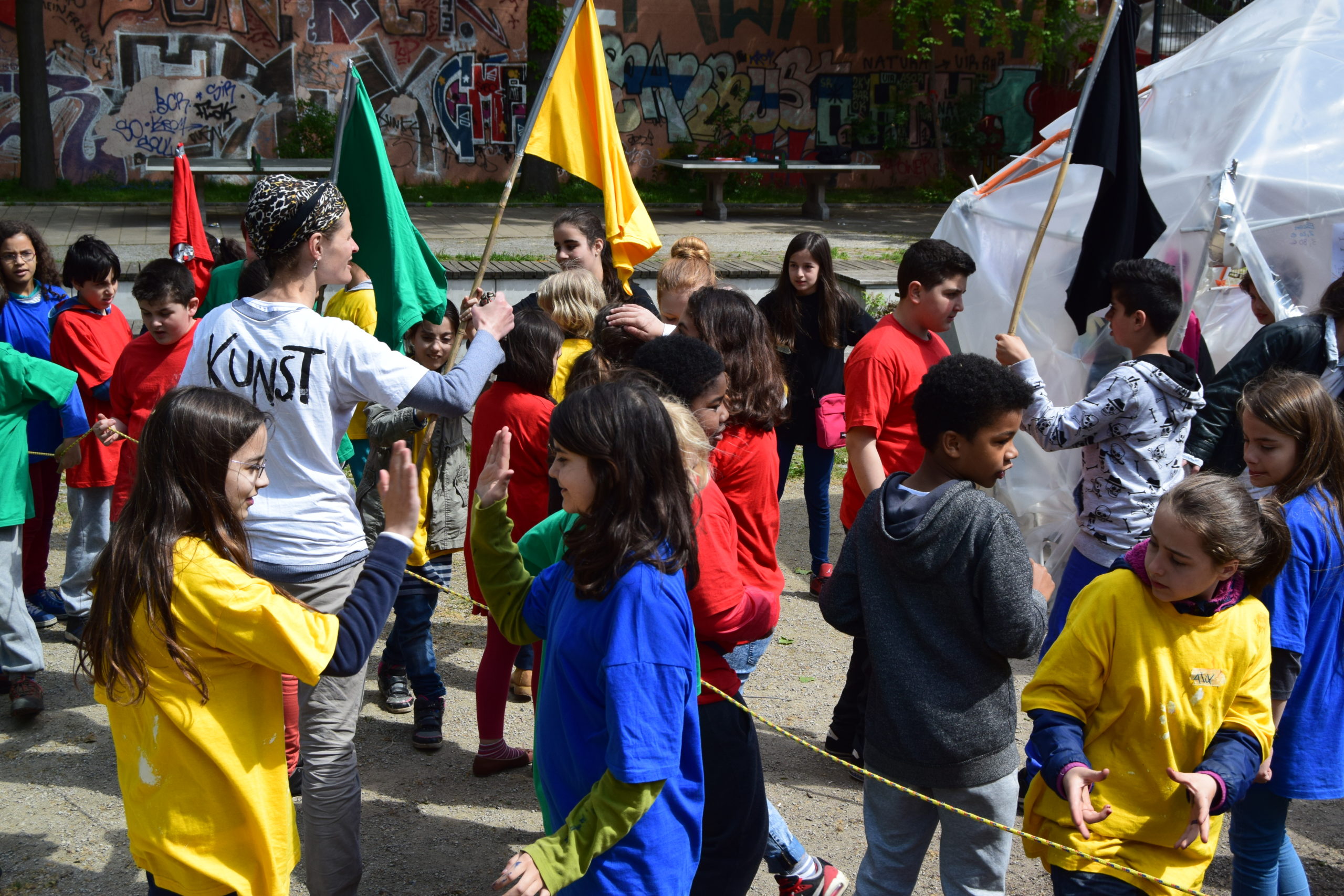
Summer camp as a communal form of freedom was something of an obsession in the first half of the last century. It reflected the longing for the utopia of an independent social construction beyond the hegemonic order. Which ideal images of a community and its common experience can we construct and make visible today? Based on this question, a campsite was organized in the schoolyard of the Nürtingen elementary school on Mariannenplatz in Kreuzberg, Berlin. In the sense of a “system of giving”, all participants were invited to bring in material objects and their own diverse knowledge. The focus was on what a school is, what can be learned and who owns the schoolyard. We created an adventure camp of collective inventions while cooking and playing sports together. During dinner debates we discussed how we can live together in a new and different system.
A guest’s view by Antonia Weisz, town clerk for Junipark:
Form and Style
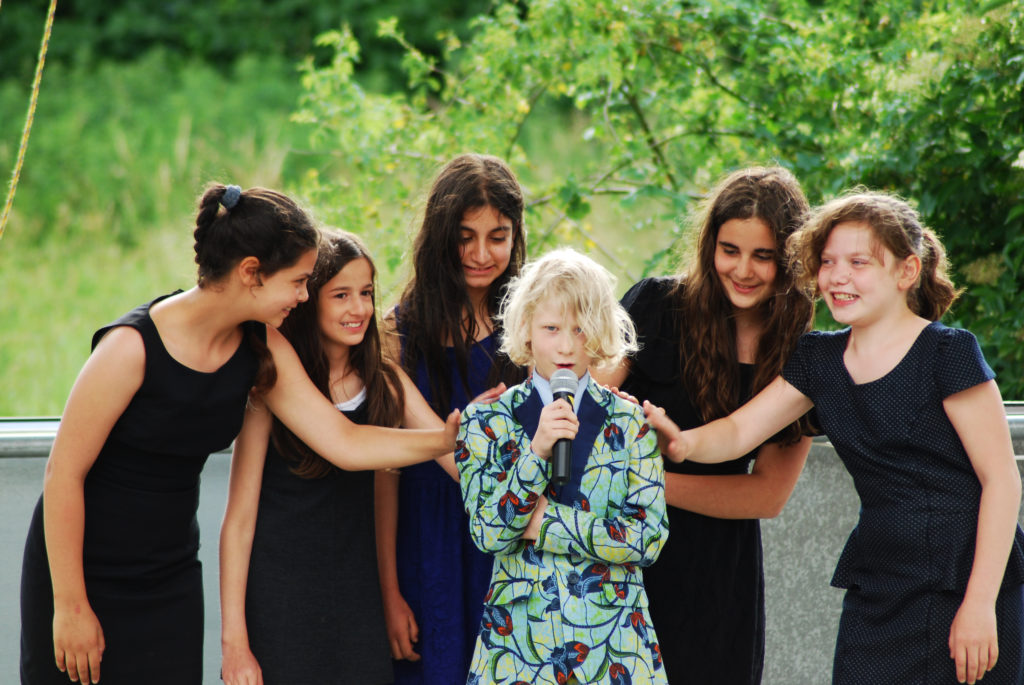
On this early evening in JUNIPARK it’s all about living utopias beyond the realms of fear. Children dream. “WELTweit…Unterwegs” (worldwide on the move) is the name of a musical installation performance with pupils in the 4th, 5th and 6th grades of Nürtingen elementary school, Kreuzberg, Berlin under the direction of Anja Scheffer, Dascha Kornysheva and DJ B.Side. Parents, teachers, neighbours and schoolmates have come to the performance – the grandstand is full. Dressed to the nines, the girls in elegant gowns, the boys in suits and ties they delineate utopian residential installations, undeterred by the fact that Berlin is a city of disappearing niches. Why not conquer the sky and build an air dome that doesn’t demand recourse to a land registry office? They even have an answer to the quote “Berlin is a metropolis in transition”. They invented a house that can walk – from one place to another, to where it’s safe, dry and sunny. And don’t complain that living space has become scarce and too expensive. They’d rather sing to us how to deal with it:
“You don’t need a high school diploma or a good figure, just tarps, nails and a piece of string. The cord is stretched, the tarpaulin’s up. The tent is ready, it’s no trick. Now it’s ready, your mobile tent, now you can live where you like.”
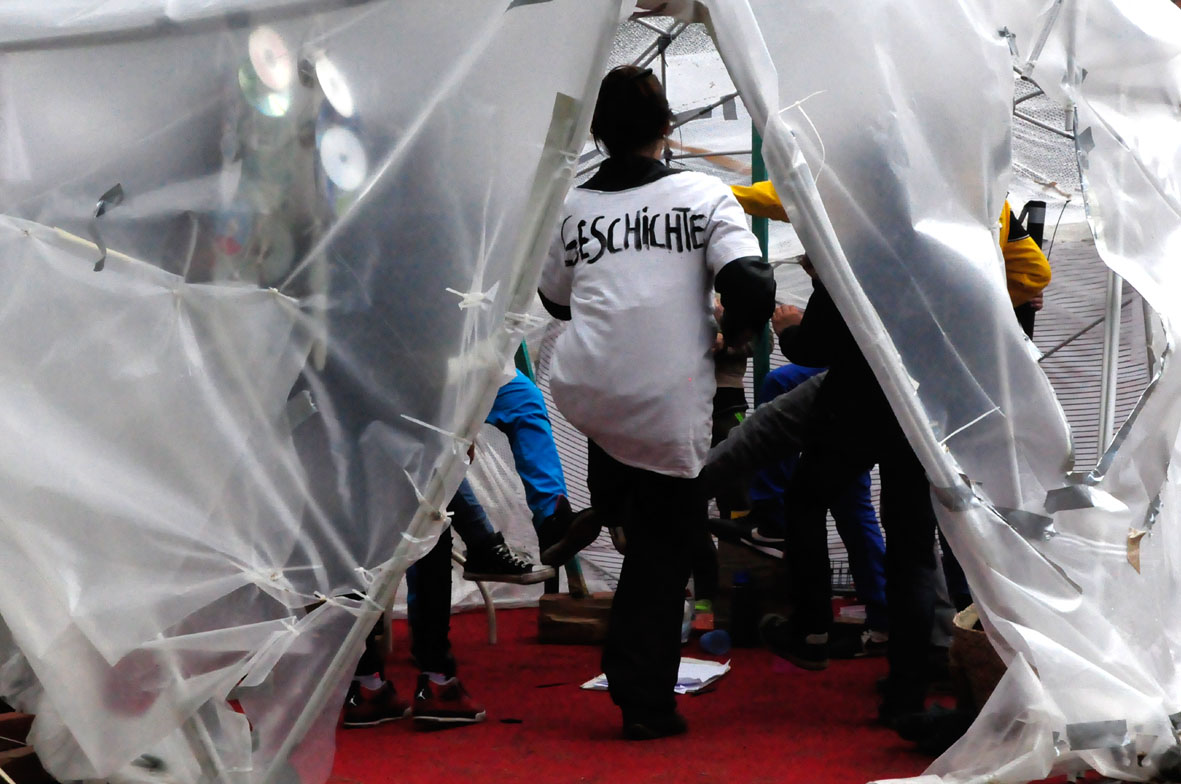
Volunteers from the audience are invited to demonstrate that many people can fit in their dancing tent. With irony, chutzpah and the courage to question themselves and everything else, they are completely serious about it. Right in there. They showcase their construction manual as a top speed monologue. They make reference to materials that determine not only the form but also the spirit of their work: They revitalize objects, reinvigorate fabrics that already had a past life, advocate the use of curtains for their constructions, as then everyone can come in – rather than doors that can always lock someone in or out. Extremely enthusiastic about design, to which they propose the taking of initiative in their own right in a critical examination of their financial options. They all work under the motto: Speedy construction in pocket money format.
As they say in their song:
Come and be creative with us, for the world is not only negative, we search like detectives for a space, and build houses for almost nothing, pockets stuffed with rip-ties, and an eye on the design. Like the phoenix from the ashes emerges a house for happiness.
In any event, one thing is clear: personal commitment cannot be bought. A playground and a dream of life. And they really get down to business at the ensuing congress, entitled: Detect vacant lots and use them professionally. The meeting is made up of high-ranking specialists: a cleaning specialist who likes to tidy up, an expert for people with a fear of heights, an improvisation expert in polystyrene construction, a professor specializing in building in balloons and Zeppelins because the sky is still free. Even a caretaker who used to be an architect is invited. He chases away moles to create spaces underground. On the side, he now runs a mole spaetzle restaurant in Munich. Urgh, that sounds at once both disgusting and tasty. Anyhow, this evening I encounter sorely needed experts. Not so much because their house building ideas could actually be implemented, but because they make us dream:
Life can be that simple. That does you good. And the choir sings it to us once more:
Children must not disappear, no, we’re settling here,
overcoming all borders, just doing it ourselves.
At the end, the audience is called upon to develop their own visions and not to sort every thought into right or wrong immediately. Ironically, a show house catalogue is provided as a creative aid. In addition, built into the scaffolding, there are two more show houses to view. To give us adults a helping hand. That makes me confident. The young Berliners have fantasies and we, the audience, are thrilled. I see faces filled with hope. And yes, it’s true: the world is not only negative, even in these politically worrying times around the world. Imagination is good for everyone.
Is the world reality or is the world just what we imagine? 60 children from the Nürtingen elementary school in Berlin-Kreuzberg spent more than a year looking for possible answers. In this urban ethnographic experiment, students examined the social diversity in their environment on the basis of video interviews. They were confronted with a wide variety of topics: asylum seekers, politics, drug dealers, immigration and government.
Using dramatic methods and video documentation, the research was made visible and tangible. The information on a wide variety of life plans and identities acquired in the interview workshop was then staged: in a three-week game, acting, directing, storytelling, costume design, visual arts and music were the motor that set a major negotiation process in motion. It turned out that identities and realities can be reconstructed. And that the rituals, self-images and attitudes can be changed, as can the world.
Who obeys totally uncool school rules that nobody understands? 75 students rewrite their school rules to convey the basic rules of living and learning together in a language and aesthetics that the students can understand.
Together with sideviews, students in grades 7-9. developed the film project “RESPECT!”, including the soundtrack. The result was six episodes on the topics of punctuality, conflicts, responsibility, behavior, school climate and discrimination, in the formats of feature films, commercials and reports. These were presented at a premiere in the Eiszeit Cinema in Kreuzberg, Berlin.
RESPECT! – A Film about the rules of living together, 2012-2013
The film was the springboard for the theatre profile of the Refik Veseli School, which started in February 2013 with the pilot “Why is it so hard to talk about love?”.
Auf der Mauer auf der Lauer – History and Art by Children for Children was a long-term project on the subject of a divided city at the Nürtingen elementary school in Kreuzberg, Berlin. It was split into three project phases between November 2009 and July 2010 with 100 children from grades 1-6.
In the first few months, the children went through an interview workshop and visited the Berlin Wall Memorial along the East Side Gallery. In addition, video interviews were conducted with contemporary witnesses from West and East who lived near the Wall, each with different experiences. The second phase consisted of a 3-week play workshop in the school, in which the knowledge acquired from the interview workshop about life in East and West could was internalized through play in a creative setting. The starting point was a wall made of 150 packing cases dividing the school auditorium into two distinct zones: “Blauland” and “Orangania” on one side or the other of which the children reacted to rules similar to those in East and West Berlin. They missed their best friends, wrote letters to each other, built musical instruments to communicate with one another, graffitied the “wall” in Orangania, invented smuggling and secret agent games as well as spoken chants and song texts, thereby chronologically and artistically delineating the history of division and unification. To conclude, the wall was collectively torn down in a slow-motion choreography.
The third phase took place in the pavilion of the Wall Memorial at Bernauer Street: the presentation of the wall project. The packing case wall,”Orangania” and “Blauland” were recreated in the space where, accompanied by the artists, the pupils developed, curated and implemented the concept for the exhibition and developed the catalogue. In between interviewing the visitors they wrote, read, painted, scanned, laid out and built. For a week, from morning to evening, the primary school students enthusiastically exhibited their work to the tourists of the world, the press and school classes from other school, presenting the project in German, English, Turkish, Spanish, Danish and Swedish. All visitors were invited to play.
Radio report by Frauke Thiele: Auf der Mauer. A feature by rbb Kulturradio.